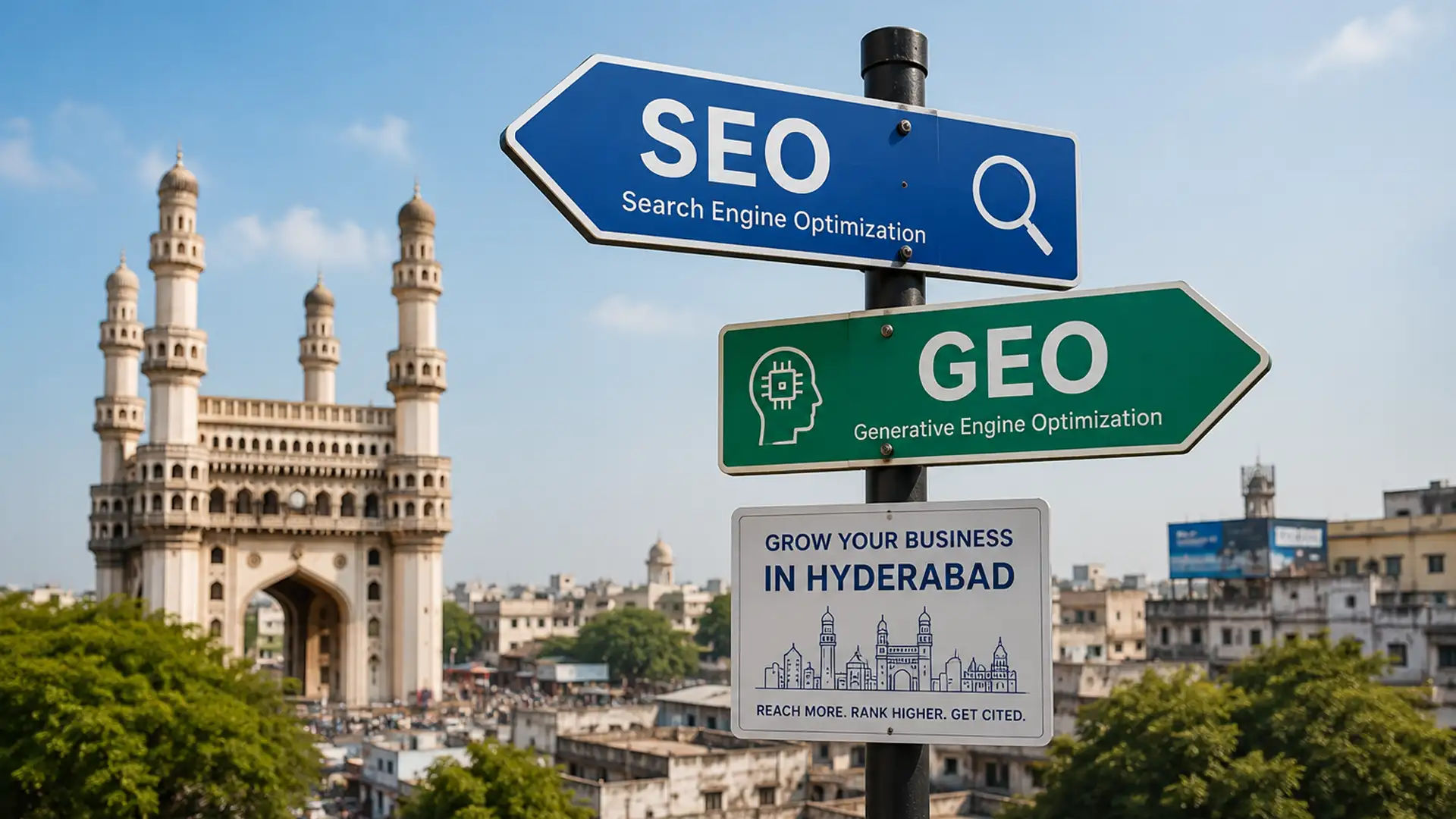
If you’ve heard the term “GEO” (Generative Engine Optimization) and wondered whether it replaces SEO, makes it obsolete, or is just another acronym to ignore — this guide is for you. The short answer: GEO doesn’t replace SEO. It sits alongside it, and in 2026, Hyderabad businesses that only do one are leaving real revenue on the table.
This guide breaks down exactly what each discipline does, where they overlap, where they diverge, and the specific steps a Hyderabad business can take this week to start working on both.
What Is SEO in 2026?
- Technical SEO — making your site crawlable by search engines, fast, mobile friendly and secure.
- On-page SEO – relevant material for the keyword, a good header structure, internal linking and metadata that characterises each page properly.
- Off-page SEO — backlinks, local citations and brand references that tell Google you’re trustworthy and an authority.
- Local SEO — Google Business Profile optimization, local keyword targeting, and location-specific content, which matters enormously for Hyderabad businesses competing in neighborhoods like Gachibowli, Banjara Hills, and Hitech City.
What Is GEO?
Generative Engine Optimization is the practice of structuring your content and brand presence so that AI-powered systems — ChatGPT, Google AI Overviews, Perplexity, Gemini — cite your business when they generate answers to user questions.
The term was formally introduced in a 2023 Princeton University research paper, and by 2026 it has become one of the fastest-growing disciplines in digital marketing — for a simple reason: a growing share of how people find businesses no longer involves a list of links at all. It involves a single, synthesized answer.
GEO isn’t about tricking AI systems or stuffing keywords. It’s about making your content easy for AI to understand, extract, and trust – via clear structure, direct replies, consistent entity information, and reputable sourcing.
Key Differences Between SEO and GEO
SEO
GEO
Goal
Rank in a list of search results
Be cited in a single AI-generated answer
User outcome
User sees multiple options, clicks one
User sees one synthesized answer
Primary signals
E-E-A-T
Content structure, entity clarity, direct answers, freshness
Content format
Keyword-optimized pages, blog posts
FAQ-structured, direct-answer paragraphs, comparison tables
Measurement
Rankings, organic traffic, click-through rate
Early-stage discipline, ~3 years
Maturity (2026)
Established discipline, ~25 years
Be cited in a single AI-generated answer
Who's doing it in Hyderabad
Most established businesses, to some degree
Very few SMEs — early-mover window still open
SEO
GEO
Goal
SEO
Rank in a list of search results
GEO
Be cited in a single AI-generated answer
User outcome
SEO
User sees multiple options, clicks one
GEO
User sees one synthesized answer
Primary signals
SEO
E-E-A-T
GEO
Content structure, entity clarity, direct answers, freshness
Content format
SEO
Keyword-optimized pages, blog posts
GEO
FAQ-structured, direct-answer paragraphs, comparison tables
Measurement
SEO
Rankings, organic traffic, click-through rate
GEO
Early-stage discipline, ~3 years
Maturity (2026)
SEO
Established discipline, ~25 years
GEO
Be cited in a single AI-generated answer
Who's doing it in Hyderabad
SEO
Most established businesses, to some degree
GEO
Very few SMEs — early-mover window still open
The most important row in this table is the last one. SEO competition in Hyderabad is intense — most established businesses have some SEO foundation. GEO competition, by contrast, is close to zero among local SMEs. That asymmetry is the opportunity.
Why Hyderabad Businesses Need Both
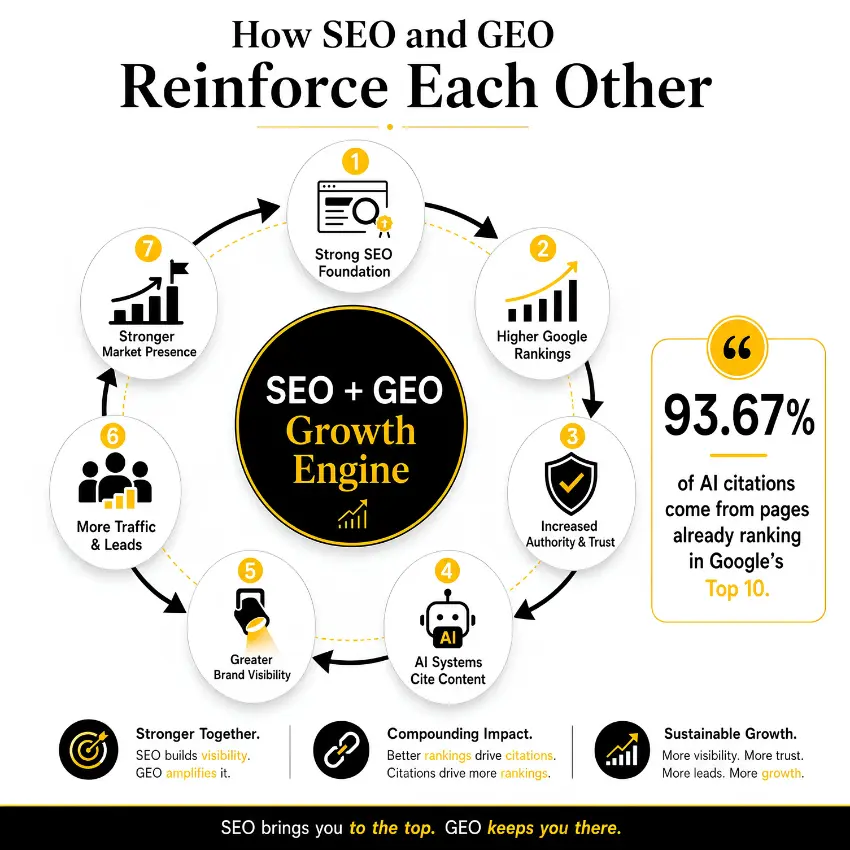
Here’s the statistic that should anchor this entire conversation: AI-powered search now accounts for roughly 27% of all search activity, according to NP Digital’s 2026 research — and that share is growing month over month. At the same time, 93.67% of Google AI Overview citations come from pages already ranking in Google’s top 10 (a figure confirmed across multiple 2026 industry studies).
What does that mean in practice for a Hyderabad business?
If you have no SEO foundation, GEO has almost nothing to build on. AI engines overwhelmingly cite content that’s already established as authoritative through traditional SEO signals — domain authority, backlinks, and rankings. A business with zero SEO presence is very unlikely to get cited by AI, no matter how well-structured a single page is.
If you have SEO but no GEO, you’re invisible to the 27%. A business that ranks well in traditional Google results but writes in dense, narrative paragraphs without FAQ structure, direct answers, or schema markup is essentially leaving the AI-search quarter of the market entirely to competitors who’ve adapted.
The two compound. Strong SEO builds the authority that makes AI citation possible. GEO-structured content — clear, direct, well-organized — also tends to perform better in traditional search, because it’s easier for both humans and machines to understand quickly. Businesses treating these as separate budgets or separate strategies are missing the compounding effect entirely.
How to Implement GEO This Week
You don’t need a developer, a redesign, or a large budget to start. Five things, in order of impact:
1. Build a real FAQ section. Take the 5-8 questions your customers actually ask — in calls, WhatsApp messages, walk-ins — and answer each one directly, in 50-100 words, as its own heading. This is the single highest-leverage GEO action available to any business.
2. Rewrite your opening paragraphs to answer directly. Every service page should state, in the first sentence or two, who you are, what you do, where you operate, and what makes you credible. Save the “our story” content for an About page.
3. Ensure that your entity is consistent everywhere. Your business name, address, service area, and category should match on your website, Google Business Profile, and every directory entry – Justdial, Sulekha, IndiaMART, and others. AI systems gain confidence in a firm by seeing it described the same way in several sources.
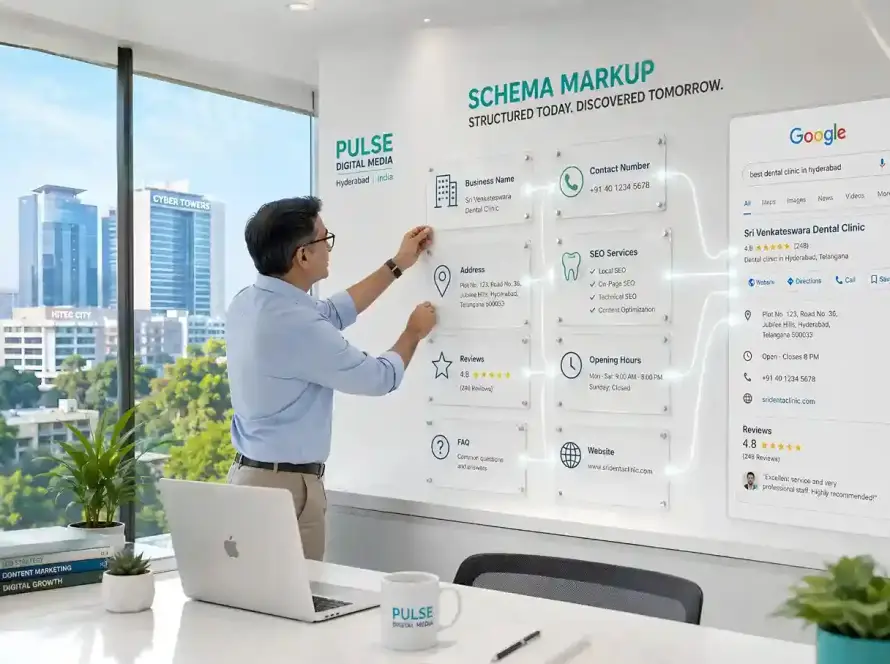
4. Add FAQ and Article schema markup. This is a technical step (your developer or web team can typically implement it in under an hour) but it’s one of the clearest signals you can send to both Google and AI crawlers about what your content is and how to use it.
5. Build one comprehensive page per core service. Instead of five thin service pages, build one genuinely thorough page per service — covering what it is, who it’s for, what it costs (or a realistic range), how long it takes, and what results to expect. Longer, more comprehensive pages consistently earn more AI citations than shorter, generic ones.
PDM's Full-Funnel Approach
At Pulse Digital Media, we don’t treat SEO and GEO as two separate engagements — because they aren’t, structurally. Our approach for Hyderabad businesses integrates:
- Technical SEO to ensure your site is fully crawlable by both Google and AI bots
- Content strategy that builds topical authority clusters — content that ranks and gets cited
- GEO structuring applied to every new and existing page: FAQs, direct answers, entity consistency, schema
- Local SEO combining Google Business Profile optimization with the entity-building work that powers local AI recommendations
- Performance tracking across both traditional rankings and AI citation frequency — because by 2026, a marketing report that only shows Google rankings is an incomplete report
This integrated approach is precisely why we built our AI & GEO Optimization service as an extension of — not a replacement for — our core SEO services.
Frequently Asked Questions
Is GEO replacing SEO?
No. The vast majority of AI citations come from pages that already rank well in traditional search — meaning SEO remains the foundation. GEO is an additional layer on top of that foundation, optimized for how AI systems select and present information.
Can a small Hyderabad business really compete in GEO against larger companies?
Yes — and this is one of GEO’s most important characteristics for SMEs.AI engines value content structure, clarity and specificity, not size or budget of the organization. A well-structured FAQ page from a focused local business can be cited ahead of a generic page from a much larger competitor.
How do I know if my business is being cited by AI tools?
You can manually test this by asking ChatGPT, Gemini, or Perplexity questions a customer might ask — “best [your service] in [your area of Hyderabad]” — and seeing whether your business appears. PDM’s audits include AI citation tracking as part of a broader visibility report.
Do I need separate content for SEO and for GEO?
No — and trying to create separate content for each is usually wasted effort. The same page, structured with direct answers, clear headings, FAQ sections, and proper schema, serves both purposes simultaneously.
What should a Hyderabad business do first — SEO or GEO?
If you have little to no existing SEO foundation, start there — GEO has very little to build on without it. If your SEO foundation is reasonably solid (you rank for some relevant terms, your GBP is active), GEO improvements can often be layered in within weeks and start showing results faster than new SEO initiatives alone.
The Hyderabad businesses that will be visible to customers in 2026 — across both Google’s results page and the AI tools increasingly mediating that first interaction — are the ones treating SEO and GEO as a single, integrated strategy rather than competing priorities.
The early-mover window in GEO is still open, but it’s closing as more businesses catch on. Get a free SEO + GEO audit from Pulse Digital Media and find out exactly where your business stands on both fronts.
📍 Pulse Digital Media — AI-Powered Digital Marketing Agency | Hyderabad & Guntur, Andhra Pradesh.
🌐 pulsedigimedia.com | 📞 +91 92 81 44 82 50 | ✉️ contact@pulsedigimedia.com.