Picture a mid-sized embedded systems company in Gachibowli. Twenty years of delivery, clients in automotive and medical devices, a team that other engineers genuinely respect.
Now search for the exact service they sell, with “Hyderabad” added on. They’re on page two. Sometimes page three.
When the founders finally notice, they usually blame competitors’ budgets or Google’s mysteries. Neither is the real problem. The website was built to reassure someone who already knew the company, not to be found by someone who didn’t.
It’s a pattern we see often across IT and engineering firms in the city, and it’s fixable. If you’re weighing up SEO for IT companies in Hyderabad, this is the honest starting point.
Engineering gets judged on outcomes: uptime, throughput, defect rates, whether the project shipped on time. Search engines judge something else entirely. Can they crawl the page, does it clearly answer the question someone typed, and do credible sites point to it? None of that depends on how good your engineers are.
Most firms in this space grew through referrals and long client relationships, which is a perfectly good way to grow. It also hides a weak website for years, because the site was never generating leads in the first place. Then the company decides to scale, or a big account winds down, and the site suddenly has a job it was never built for.
There’s a mindset piece too. The website usually gets treated as a brochure: services, about us, contact. But B2B SEO rewards companies that show their expertise in a form buyers and search engines can actually find and understand. The stakes are higher in 2026, too. More searches now get answered without a click, so the visitors who do arrive are fewer and more serious, and a weak site wastes them.
Open most engineering company sites and you’ll find capability statements, “end-to-end solutions” language and a wall of technology logos. Now think about what a buyer actually types: how to migrate a legacy ERP without downtime, what to look for when outsourcing firmware development, or roughly what it costs to build a SaaS product in India.
Buyers search for problems, comparisons, costs and risks. Companies publish about themselves. That mismatch is the single biggest reason strong firms don’t rank.
It gets worse because B2B buying is a committee decision. The technical evaluator wants architecture detail, procurement wants compliance and commercial clarity, and the sponsor wants proof it worked. Content aimed at only one of them leaves the others with nothing to find.
Teams that build sophisticated systems often run websites with basic technical SEO problems. These are the ones we find most often.
Slow, heavy pages. Uncompressed images, render-blocking scripts and bloated themes hurt rankings and patience alike. Google’s Core Web Vitals give you clear targets: your biggest visible element loading in under 2.5 seconds, taps responding in under 200 milliseconds, and almost no layout jumping.
Content hidden behind JavaScript. If your key text only appears after client-side rendering, crawlers may miss it or pick it up late. Engineering teams love modern frameworks. Search engines are less enthusiastic.
One generic “Services” page. A single page listing twelve services can’t rank for any of them. Each service and industry needs its own page with real detail, not boilerplate copied from one page to the next.
Weak on-page basics. Missing or duplicate title tags, vague meta descriptions, multiple H1s or none at all, and blog posts, case studies and service pages that never link to each other.
Indexing accidents. A leftover “noindex” tag from a staging site, a robots.txt rule blocking a key folder, or redirect chains after a redesign can quietly remove pages from search.
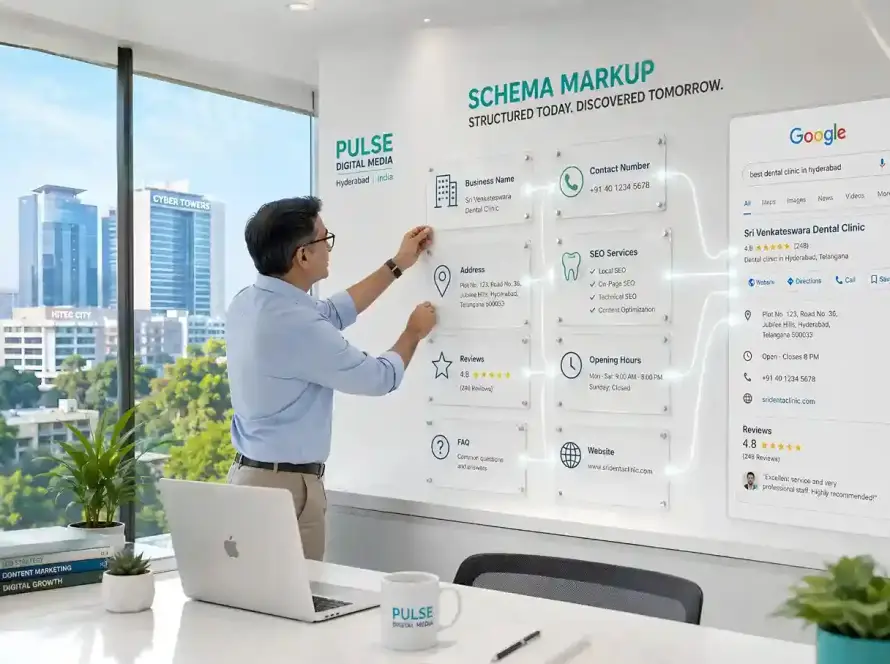
Case studies locked in PDFs, and no structured data. Your best proof is often the least searchable content on the site, and without schema markup you’re leaving search engines and AI tools to guess what your pages mean.
Buyers do most of their research before they ever speak to a vendor. They shortlist quietly, and more of that now happens through AI assistants and AI-generated search summaries. The questions get longer and more conversational: “Which Hyderabad companies build medical device firmware and hold ISO 13485 certification?”
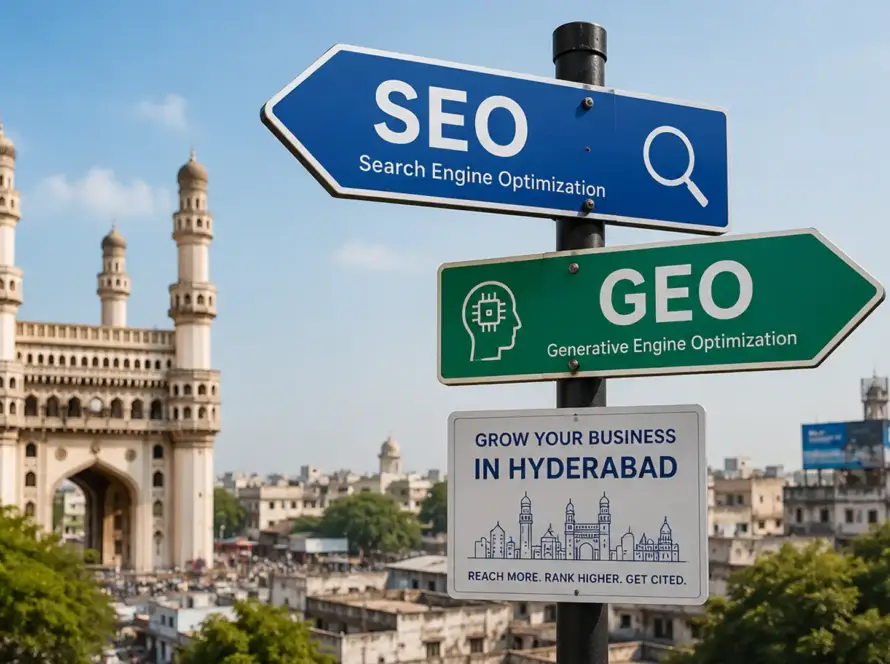
AI systems build answers from sources they can parse and trust. That’s the idea behind GEO for B2B (generative engine optimisation): making your company easy to find, understand and cite. In practice, specific and verifiable claims beat vague ones. “Delivered 40+ embedded projects for automotive clients” gives an AI something to work with; “innovative, cutting-edge solutions” gives it nothing. Clear FAQs help, as does keeping your company name, services, location and certifications consistent across your website, LinkedIn and directories, and earning mentions from partner pages and technical publications.
GEO doesn’t replace traditional SEO. A crawlable, well-structured site is the foundation for both. If you want the fuller picture, our guide to what GEO actually means is a good next read.
If you’re stuck on page two, work through this in order.
Start with a crawl and indexation check, because nothing else matters if your important pages can’t be indexed. Then fix the speed basics: compress images and remove unused scripts. Next, build a dedicated page for each service and industry, and turn your PDF case studies into web pages built around the problem, the approach and a measurable result.
Then ask your sales team for the ten questions prospects raise most often, and publish a thorough answer to each. Link those pages together, add schema, and put a named engineer with a short bio behind your technical articles, since real authorship is one of the clearest trust signals in Google’s E-E-A-T guidelines. Keep your company details identical everywhere they appear online, and earn mentions through directories and partner pages.
Finally, the fastest win: filter Google Search Console for queries where you rank in positions 11 to 20. A stronger page, better internal links or a content refresh can push these almost-there keywords onto page one.
Track progress through non-brand impressions, service-specific rankings and enquiry quality, not just raw traffic.
Frequently Asked Questions
How long does it take to move from page two to page one?
Technical solutions will be apparent within weeks, while new content and authority will need a couple of months, based on the competition in your field.
Should we do a total redesign of our website?
Usually not. Most page-2 problems come from indexing, content structure and missing pages, not from how the site looks.
Ready to Move Off Page 2 ?
Your engineering doesn’t need to get better. Your visibility does. If you run an IT or engineering company and suspect your website is holding back your pipeline, get in touch for a free SEO audit for B2B and engineering companies. We’ll review your technical health, content gaps and AI-search readiness, then send you a prioritised action plan in plain terms, no jargon.