Most Hyderabad business owners have heard the phrase “schema markup” somewhere — in an SEO audit, from a developer, maybe in a digital marketing pitch. Very few know what it actually does, why it matters right now specifically, or how to implement it without paying someone ₹15,000 for what is often a 30-minute task.
This guide covers all of it. By the end, you’ll know what schema markup is in plain language, which types your business needs, exactly how to add it without touching code, and why getting this right in 2026 is more important than it’s ever been — because AI search has changed the game entirely.
What Schema Markup Is — A Plain-Language Explanation
Think of Google as a very fast reader who has to understand millions of websites every day. When Google reads your website, it can see your words — but understanding the meaning of those words is harder. Your business name looks like text. Your opening hours look like text. Your service list looks like text. Without context, Google has to guess what role each piece of text plays.
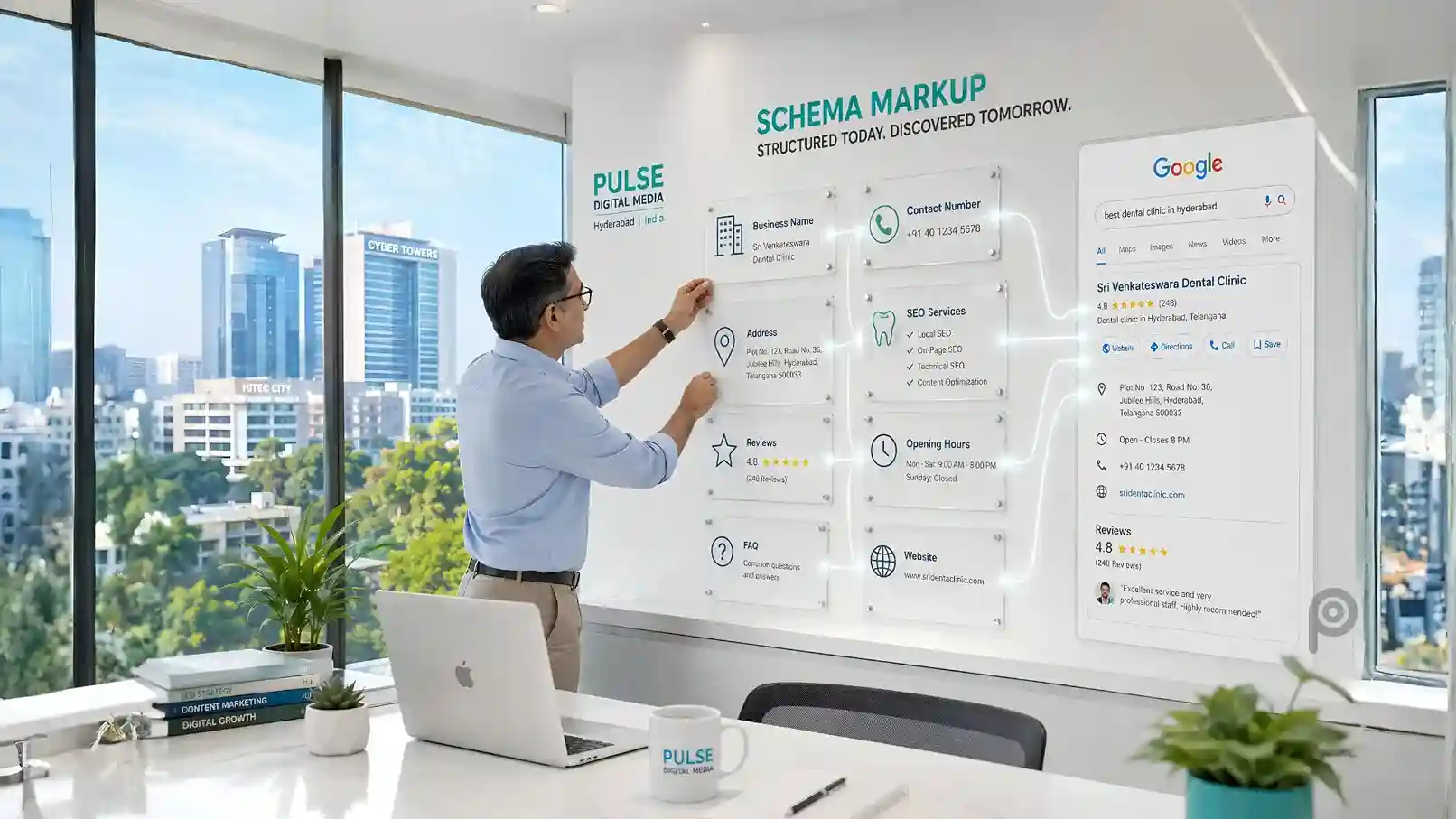
Schema markup gives Google that context. It’s a standardized vocabulary — maintained at https://schema.org, a project run jointly by Google, Microsoft, Yahoo, and Yandex — that lets you label your content in a way machines understand precisely. Instead of Google guessing that “9am to 7pm, Monday to Saturday” are your opening hours, schema markup explicitly says: “These are this business’s operating hours, on these days, within these times.”
That explicit understanding is what powers the features you see in search results that competitors with no schema simply don’t get: FAQ dropdowns beneath listings, star ratings, business hours displayed directly in results, knowledge panel data, and the voice search answers that AI assistants read out.
Schema markup is added to your website’s HTML as a block of structured code — most commonly in a format called JSON-LD, which Google recommends and which sits in the page’s
<head> section without affecting anything the user sees. It’s invisible to visitors. It’s very visible to search engines.Why Hyderabad Businesses Specifically Need This More Than Anyone
In cities like London or New York, schema adoption among local businesses is still below 30%. In Hyderabad, it’s lower. Surveys of local business websites across Telangana in 2025–2026 consistently find that fewer than 1 in 10 SME sites have any structured data implemented correctly. Among those that do have it, the majority have only partial implementation — a LocalBusiness schema with missing fields, or FAQ schema that doesn’t match the actual FAQ content on the page.
What this means for your business: the bar to stand out is remarkably low. In Gachibowli, Banjara Hills, Kondapur, Hitech City, Ameerpet, or wherever your business is located, there’s a very high probability that your direct competitors have no schema at all. Implementing it fully and correctly puts you in a completely different category in how Google understands and displays your business.
The three specific benefits for Hyderabad local businesses:
Rich results and higher click-through rates. A business listing in Google search that shows FAQ dropdowns, star ratings, and business details gets clicked significantly more than a plain blue link. Multiple studies across markets put the click-through rate advantage at 20–35% for rich result formats vs standard listings. In a competitive local market, that’s a meaningful difference in how many people visit your website each day.
Local pack prominence. The local pack — the map block that appears for “near me” and location-based searches — is driven primarily by Google Business Profile data, but schema on your website reinforces it. Businesses with consistent, complete LocalBusiness schema that matches their GBP data signal to Google that their business information is reliable, which correlates with better local pack placement.
AI search visibility. In 2026, roughly 27% of mobile searches in urban India are answered by AI-powered features — Google’s AI Overviews, Gemini, voice assistants. These systems extract structured information from websites to build their answers. A website with schema markup is dramatically easier for AI to extract from than a website without it. A Hyderabad business asking “why doesn’t Google mention my business when someone asks for [service] in [neighborhood]?” often finds schema is the missing piece.
The 5 Schema Types Every Local Business in Hyderabad Must Have
In cities like London or New York, schema adoption among local businesses is still below 30%. In Hyderabad, it’s lower. Surveys of local business websites across Telangana in 2025–2026 consistently find that fewer than 1 in 10 SME sites have any structured data implemented correctly. Among those that do have it, the majority have only partial implementation — a LocalBusiness schema with missing fields, or FAQ schema that doesn’t match the actual FAQ content on the page.
What this means for your business: the bar to stand out is remarkably low. In Gachibowli, Banjara Hills, Kondapur, Hitech City, Ameerpet, or wherever your business is located, there’s a very high probability that your direct competitors have no schema at all. Implementing it fully and correctly puts you in a completely different category in how Google understands and displays your business.
The three specific benefits for Hyderabad local businesses:
Rich results and higher click-through rates. A business listing in Google search that shows FAQ dropdowns, star ratings, and business details gets clicked significantly more than a plain blue link. Multiple studies across markets put the click-through rate advantage at 20–35% for rich result formats vs standard listings. In a competitive local market, that’s a meaningful difference in how many people visit your website each day.
Local pack prominence. The local pack — the map block that appears for “near me” and location-based searches — is driven primarily by Google Business Profile data, but schema on your website reinforces it. Businesses with consistent, complete LocalBusiness schema that matches their GBP data signal to Google that their business information is reliable, which correlates with better local pack placement.
AI search visibility. In 2026, roughly 27% of mobile searches in urban India are answered by AI-powered features — Google’s AI Overviews, Gemini, voice assistants. These systems extract structured information from websites to build their answers. A website with schema markup is dramatically easier for AI to extract from than a website without it. A Hyderabad business asking “why doesn’t Google mention my business when someone asks for [service] in [neighborhood]?” often finds schema is the missing piece.
1. LocalBusiness Schema
This is the most critical schema type for any business with a physical location or a defined service area. It tells Google, in machine-readable format, exactly what your business is: name, address, phone, website URL, opening hours, price range, geographic service area, and business category.
The full documentation is at https://developers.google.com/search/docs/appearance/structured-data/local-business. A correctly implemented LocalBusiness schema for a digital marketing agency in Hyderabad looks like this:
{
  "@context": "https://schema.org",
  "@type": "ProfessionalService",
  "name": "Pulse Digital Media",
  "description": "AI-powered digital marketing agency in Hyderabad offering SEO, GEO,
 social media marketing, and web development for businesses across Telangana and Andhra Pradesh.",
  "url": "https://pulsedigimedia.com",
  "telephone": "+91-92814-48250",
  "email": "contact@pulsedigimedia.com",
  "address": {
    "@type": "PostalAddress",
    "streetAddress": "Your Street Address",
    "addressLocality": "Hyderabad",
    "addressRegion": "Telangana",
    "postalCode": "500032",
    "addressCountry": "IN"
  },
  "openingHoursSpecification": [
    {
      "@type": "OpeningHoursSpecification",
      "dayOfWeek": ["Monday","Tuesday","Wednesday","Thursday","Friday","Saturday"],
      "opens": "09:00",
      "closes": "19:00"
    }
  ],
  "areaServed": ["Hyderabad", "Secunderabad", "Guntur", "Vijayawada"],
  "priceRange": "₹₹",
  "sameAs": [
    "https://www.facebook.com/pulsedigimedia/",
    "https://www.linkedin.com/company/98508614/",
    "https://www.instagram.com/pulsedigimedia/"
  ]
}
The
sameAs property is one most implementations miss — it links your schema entity to your social profiles, which strengthens Google’s understanding of your brand across the web and directly improves your knowledge panel completeness.2. FAQPage Schema
For any page with a list of questions and answers — your services page, your FAQ page, even the FAQ section at the bottom of a blog post — FAQPage schema marks up each question and answer pair in a way that Google can display directly in search results as expandable dropdowns.
This is the schema type with the fastest and most visible impact. Once implemented and crawled, your search listing can expand to show 3–4 questions below the main link. Users can read the answer before clicking. This both increases click-through for the right queries and qualifies traffic — people who click through have already confirmed your content matches what they’re looking for.
A FAQ Page schema example for a service page:
{
  "@context": "https://schema.org",
  "@type": "FAQPage",
  "mainEntity": [
    {
      "@type": "Question",
      "name": "How long does SEO take to show results for a Hyderabad business?",
      "acceptedAnswer": {
        "@type": "Answer",
        "text": "Most Hyderabad businesses see measurable improvement in search rankings
 within 90 to 120 days of a structured SEO campaign. Local SEO changes — particularly Google
 Business Profile optimization and schema implementation — can show results faster,
 sometimes within 3–4 weeks."
      }
    },
    {
      "@type": "Question",
      "name": "What is GEO optimization and how is it different from SEO?",
      "acceptedAnswer": {
        "@type": "Answer",
        "text": "GEO (Generative Engine Optimization) is the practice of structuring
your content to be cited by AI-powered search systems like ChatGPT, Gemini, and
Google AI Overviews. Unlike traditional SEO which targets Google's ranked results list,
 GEO targets the single synthesized answer these systems generate.
 Both are important in 2026 — SEO builds the authority that makes GEO possible."
      }
    }
  ]
}
3. AggregateRating / Review Schema
Star ratings in search results come from Review schema implemented on your website — not from Google reviews or third-party platforms. Google’s guidelines require that the reviews being marked up must actually exist on your page in a format users can read.
If your website includes customer testimonials, case study outcomes, or a reviews section, adding AggregateRating schema displays your average rating as yellow stars beneath your search listing. The CTR lift from star ratings is one of the most consistently documented improvements in technical SEO.
4. Service Schema
Most local businesses have multiple services, but their schema treats the entire website as one undifferentiated entity. Service schema lets you describe each individual service as a discrete entity with its own name, description, and service area. For a digital marketing agency this means separate Service schema blocks for SEO, social media management, web design, content creation, and so on.
This allows Google to match your specific service pages to specific service-based queries — “best social media agency in Hyderabad” and “SEO services Banjara Hills” can each find their specific matching page on your site, rather than competing with each other for attention.
5. HowTo Schema
This is the underused one — and for service businesses in Hyderabad, it’s an opportunity that almost no competitor is taking. HowTo schema marks up step-by-step process content in a way that Google can display as a structured list in search results.
If you’re a web design agency and you have a page explaining “How to brief a web design project,” implementing HowTo schema makes that content eligible to appear as a numbered step list directly in search results. For any business that publishes process-oriented content — how to apply for a service, how to prepare for a consultation, how to evaluate a vendor — this schema type generates rich result formats that your competitors almost certainly don’t have.
The full HowTo schema specification is at https://schema.org/HowTo.
Step-by-Step: How to Implement Schema Without a Developer
This is the part most guides skip over or make sound harder than it is. Here are three practical methods, from no-code to full control.
Method 1: Google's Structured Data Markup Helper (Zero Code)
Go to https://www.google.com/webmasters/markup-helper/. Select “Local Businesses” as the data type, paste your website URL or HTML, and the tool loads your page. You then click on elements — your business name, phone number, address, hours — and the tool asks you to label them using a dropdown. It generates the complete JSON-LD code for you. Copy it, add it to your page’s
<head> section (or give it to your web developer to paste in), and you’re done.Total time for a first-time user: 25–35 minutes.
Method 2: WordPress Plugin (Recommended for WordPress Sites)
If your website runs on WordPress — which the majority of Hyderabad SME sites do — install Rank Math (free version covers all the schema types listed here). Under Rank Math’s Schema settings, add your business details once, and the plugin handles the code generation and insertion automatically across your site. It covers LocalBusiness, FAQPage, HowTo, and AggregateRating without any manual code editing.
Yoast SEO Premium is an alternative with similar capabilities. Rank Math’s free version is sufficient for most local businesses.
Method 3: Direct JSON-LD Implementation (Full Control)
For businesses with a developer or a technical team member, paste JSON-LD blocks directly into your page’s
<head> section. This gives you the most control and the cleanest implementation. Use the Schema.org documentation at https://schema.org/LocalBusiness as your reference for available properties.
After any implementation method, validate immediately using https://search.google.com/test/rich-results. Paste your URL and the tool confirms what Google has detected, flags any missing required fields, and shows a preview of how your rich result will appear.
Common Implementation Mistakes to Avoid
Missing the
sameAs property. This connects your schema entity to your social profiles and is one of the most commonly skipped fields. It significantly strengthens your brand entity recognition.Inconsistent NAP data. Your Name, Address, and Phone number in schema must be identical to your Google Business Profile and every directory listing. Even minor variations — “Rd” vs “Road,” “+91 92814” vs “+91-92814” — create entity confusion that weakens both your local SEO and your schema signals.
Marking up content that isn’t on the page. FAQ schema that references questions not actually visible on the page violates Google’s guidelines and can result in manual action. Only mark up content that’s genuinely present and readable on the page.
Not updating schema when business details change. New hours, new phone number, new service — update your schema. Stale schema with outdated information actively misleads Google and can negatively affect your local pack ranking.
How Schema Connects to GEO — The 2026 Advantage
The most significant shift in search behavior in 2026 is the rise of AI-generated answers. Google AI Overviews, Gemini, ChatGPT browsing, and Perplexity are increasingly the first place users interact with information about local businesses — before they ever click a search result.
These AI systems are not reading your website the way a human does. They’re processing structured data signals to build a reliable picture of what your business is and what it offers. Schema markup is the most direct way to provide those signals in a format that AI systems are specifically designed to consume.
FAQPage schema enables AI extraction — when an AI system is generating an answer to “What does an SEO agency in Hyderabad charge?” it specifically looks for FAQ-structured content with clear question-answer pairs. A page with FAQPage schema is signaling: “here is exactly the format you need, with the precise question and a direct answer.” That signal makes AI citation dramatically more reliable than pulling from flowing paragraph text.
LocalBusiness schema enables local AI recommendations — when someone asks Google AI “Best web design agency near Kondapur,” the AI draws on structured business entity data including what’s in your schema, your GBP, and third-party mentions. A business with complete, consistent LocalBusiness schema across multiple sources is far more likely to be recommended than one relying on unstructured text alone.
The intersection of schema and GEO is documented in Google’s structured data introduction at https://developers.google.com/search/docs/appearance/structured-data/intro-structured-data — worth bookmarking as Google updates these guidelines regularly.
Frequently Asked Questions
Does schema markup directly improve Google rankings?
Schema markup doesn’t act as a direct ranking factor in Google’s core algorithm, but it influences rankings indirectly in two significant ways. First, rich results generated by schema (FAQ dropdowns, star ratings, structured knowledge panels) improve click-through rates, and CTR is a behavioral signal that affects rankings. Second, complete, accurate schema improves entity recognition — Google’s confidence in what your business is — which correlates with better local pack and knowledge panel visibility.
How do I implement HowTo schema on my website?
Create a page or section with numbered, sequential steps describing a process relevant to your services. Each step should have a clear heading and description. Then add HowTo JSON-LD to the page’s
<head> section, with each step marked as a HowToStep with a name and text. Alternatively, use Rank Math’s HowTo block in the WordPress editor, which generates the schema automatically. Validate with the Rich Results Test at https://search.google.com/test/rich-results after implementation.Can I have multiple schema types on the same page?
Yes — multiple JSON-LD blocks on the same page are fully supported and encouraged. Your homepage, for example, might have LocalBusiness schema and FAQPage schema simultaneously. A services page might have Service schema and FAQPage schema. Each block is read independently by Google. Just ensure they don’t contradict each other — your business name and address should be consistent across all schema blocks on the site.
How long before schema changes appear in search results?
Google typically recrawls pages within a few days to a few weeks of changes, depending on your site’s crawl frequency and domain authority. Rich results generated by schema usually become visible in 2–4 weeks for regularly crawled sites. You can accelerate this by submitting the updated URL to Google Search Console for recrawling after implementing schema.
Schema markup is the single most underleveraged technical SEO asset available to Hyderabad local businesses in 2026. The implementation time is low. The competitive adoption is low. The impact — particularly as AI search continues to grow as a share of how customers find and evaluate businesses — is high and increasing.
The five schema types covered in this guide — LocalBusiness, FAQPage, AggregateRating, Service, and HowTo — are not advanced technical work. They’re foundational infrastructure that should be in place on every Hyderabad business website. The fact that most aren’t is the opportunity.
If you want to know exactly where your schema stands, what’s missing, and what it’s costing you in rich results and AI citations, request a free technical SEO audit from Pulse Digital Media. We’ll give you a specific implementation checklist for your site within 48 hours.
Pulse Digital Media | Hyderabad & Guntur | pulsedigimedia.com | +91 92 81 44 82 50 | contact@pulsedigimedia.com